
Istio service mesh
on a single sheet.
A dense reference for senior platform engineers and SREs. Traffic management, security, observability, performance, multi-cluster and the failure modes you actually hit in production. No beginner slides.
Preview (3 pages, A4 landscape)
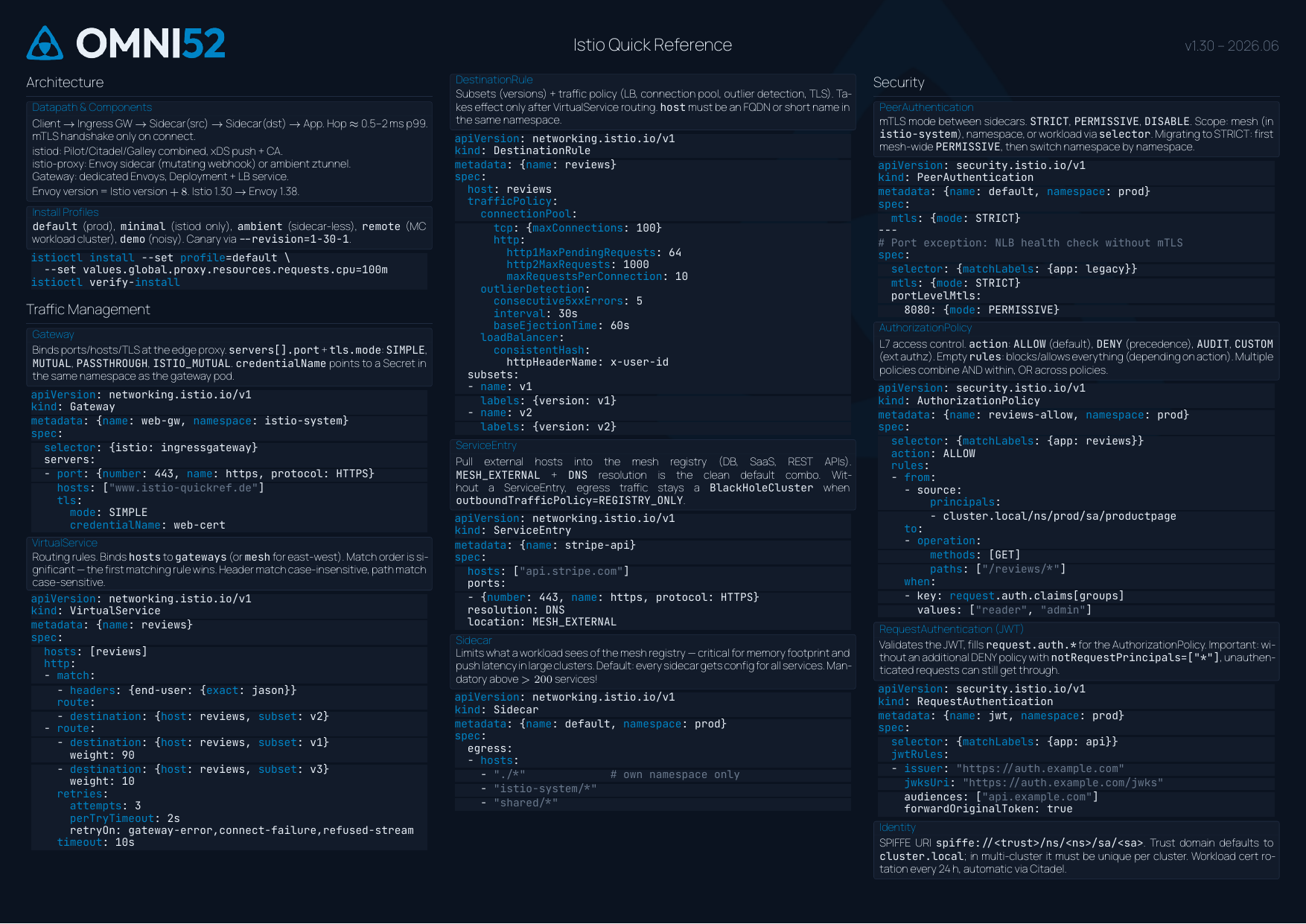
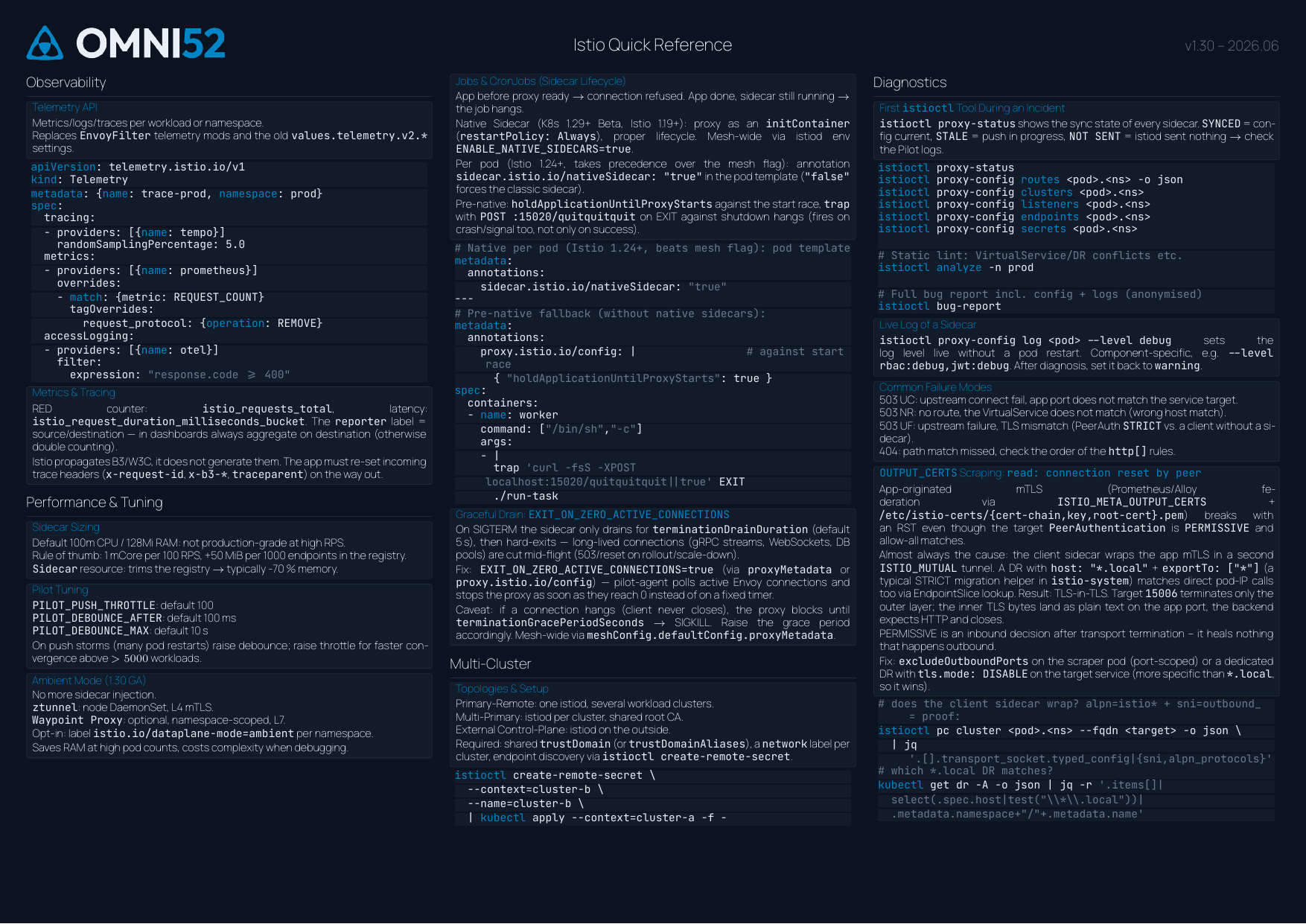
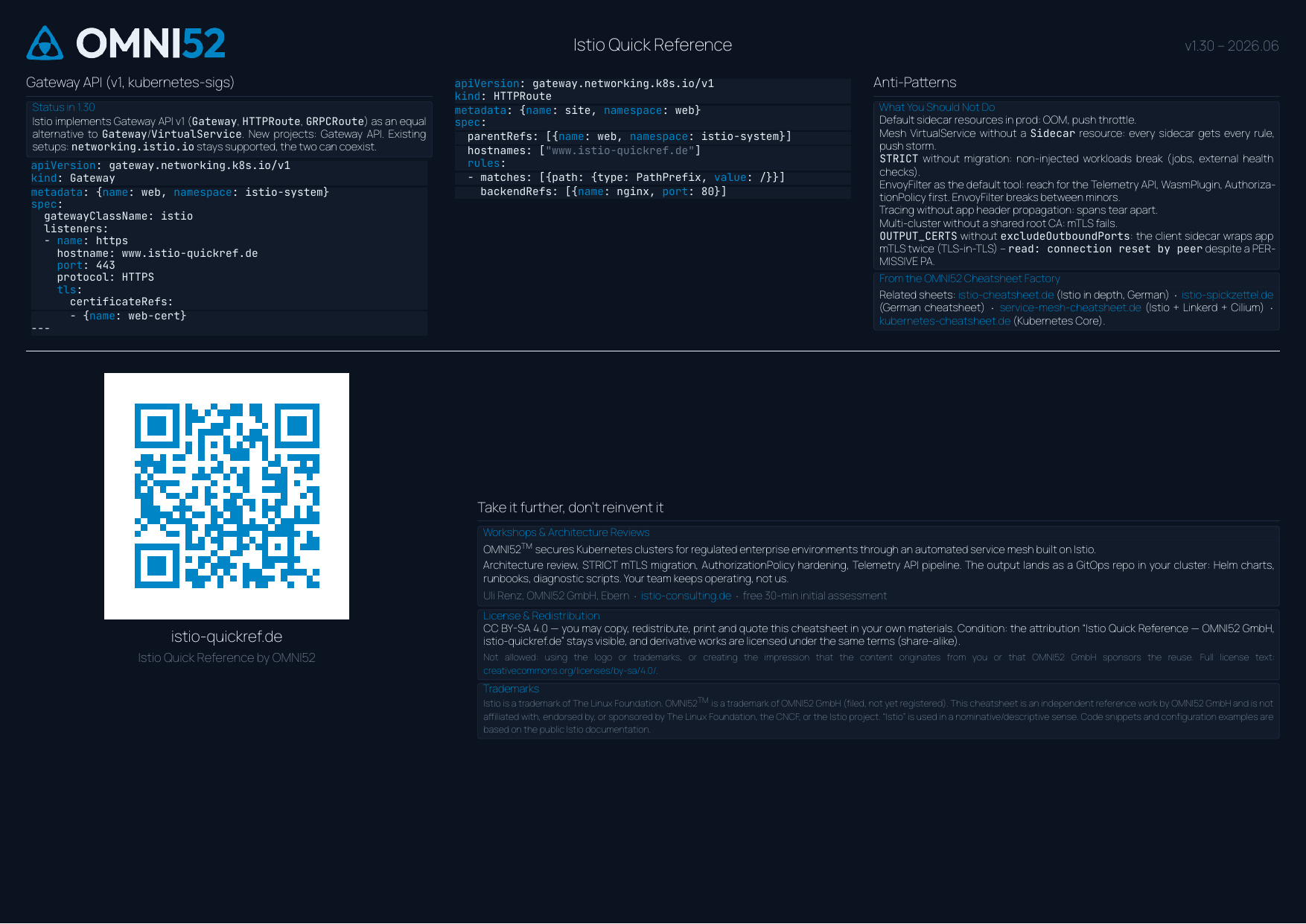
Download the PDF
Direct download, no email required. CC BY-SA 4.0, copying, printing and redistributing is explicitly allowed as long as the attribution stays visible.
What’s inside
Traffic
Gateway, VirtualService, DestinationRule, ServiceEntry, Sidecar scoping, with outlier detection and connection-pool defaults.
Security
PeerAuthentication, AuthorizationPolicy with JWT claims, RequestAuthentication, SPIFFE identity, migration pattern for mTLS STRICT.
Observability
Telemetry API, the metrics that matter from the Envoy stack, tracing header propagation, OTel logging with filters.
Performance
Sidecar sizing rules of thumb, Pilot tuning for push storms, ambient mode (1.30 GA) as the sidecar-less option.
Multi-cluster
Primary-remote, multi-primary, external control plane. Trust-domain setup and endpoint discovery in one block.
Diagnostics
istioctl tools in the order you reach for them during an incident. Typical 503 UC/NR/UF codes with root cause.
Full-text cheatsheet
The same content as the PDF, to read along, search and copy the YAML snippets directly. As of: Istio 1.30 (v1.30 · 2026.08).
Architecture
Datapath & components
Client → ingress GW → sidecar(src) → sidecar(dst) → app. Hop ≈ 0.5–2 ms p99. mTLS handshake only on connect.
istiod: Pilot/Citadel/Galley combined, xDS push + CA. istio-proxy: Envoy sidecar (mutating webhook) or ambient ztunnel. Gateway: dedicated Envoys, Deployment + LB service.
Envoy version = Istio version + 8. Istio 1.30 → Envoy 1.38.
Install profiles
default (prod), minimal (istiod only),
ambient (sidecar-less), remote
(MC workload cluster), demo (noisy). Canary via
--revision=1-30-1.
istioctl install --set profile=default \
  --set values.global.proxy.resources.requests.cpu=100m
istioctl verify-install
Traffic Management
Gateway
Binds ports/hosts/TLS at the edge proxy. servers[].port
+ tls.mode: SIMPLE, MUTUAL,
PASSTHROUGH, ISTIO_MUTUAL.
credentialName points to a Secret in the same namespace
as the gateway pod.
apiVersion: networking.istio.io/v1
kind: Gateway
metadata: {name: web-gw, namespace: istio-system}
spec:
  selector: {istio: ingressgateway}
  servers:
  - port: {number: 443, name: https, protocol: HTTPS}
    hosts: ["www.istio-quickref.de"]
    tls:
      mode: SIMPLE
      credentialName: web-cert
VirtualService
Routing rules. Binds hosts to gateways
(or mesh for east-west). Match order is significant
, the first matching rule wins. Header match is
case-insensitive, path match is case-sensitive.
apiVersion: networking.istio.io/v1
kind: VirtualService
metadata: {name: reviews}
spec:
  hosts: [reviews]
  http:
  - match:
    - headers: {end-user: {exact: jason}}
    route:
    - destination: {host: reviews, subset: v2}
  - route:
    - destination: {host: reviews, subset: v1}
      weight: 90
    - destination: {host: reviews, subset: v3}
      weight: 10
    retries:
      attempts: 3
      perTryTimeout: 2s
      retryOn: gateway-error,connect-failure,refused-stream
    timeout: 10s
DestinationRule
Subsets (versions) + traffic policy (LB, connection pool,
outlier detection, TLS). Takes effect only after VirtualService
routing. host must be an FQDN or a short name in the
same namespace.
apiVersion: networking.istio.io/v1
kind: DestinationRule
metadata: {name: reviews}
spec:
  host: reviews
  trafficPolicy:
    connectionPool:
      tcp: {maxConnections: 100}
      http:
        http1MaxPendingRequests: 64
        http2MaxRequests: 1000
        maxRequestsPerConnection: 10
    outlierDetection:
      consecutive5xxErrors: 5
      interval: 30s
      baseEjectionTime: 60s
    loadBalancer:
      consistentHash:
        httpHeaderName: x-user-id
  subsets:
  - name: v1
    labels: {version: v1}
  - name: v2
    labels: {version: v2}
ServiceEntry
Pulls external hosts into the mesh registry (DB, SaaS, REST APIs).
MESH_EXTERNAL + DNS resolution is the clean
default combo. Without a ServiceEntry, egress traffic stays a
BlackHoleCluster when
outboundTrafficPolicy=REGISTRY_ONLY.
apiVersion: networking.istio.io/v1
kind: ServiceEntry
metadata: {name: stripe-api}
spec:
  hosts: ["api.stripe.com"]
  ports:
  - {number: 443, name: https, protocol: HTTPS}
  resolution: DNS
  location: MESH_EXTERNAL
Sidecar
Limits what a workload sees of the mesh registry, critical for memory footprint and push latency in large clusters. Default: every sidecar gets config for all services. Mandatory above > 200 services.
apiVersion: networking.istio.io/v1
kind: Sidecar
metadata: {name: default, namespace: prod}
spec:
  egress:
  - hosts:
    - "./*"             # own namespace only
    - "istio-system/*"
    - "shared/*"
Security
PeerAuthentication
mTLS mode between sidecars. STRICT,
PERMISSIVE, DISABLE. Scope: mesh (in
istio-system), namespace, or workload via
selector. Migrating to STRICT: first
mesh-wide PERMISSIVE, then switch namespace by namespace.
apiVersion: security.istio.io/v1
kind: PeerAuthentication
metadata: {name: default, namespace: prod}
spec:
  mtls: {mode: STRICT}
---
# Port exception: NLB health check without mTLS
spec:
  selector: {matchLabels: {app: legacy}}
  mtls: {mode: STRICT}
  portLevelMtls:
    8080: {mode: PERMISSIVE}
AuthorizationPolicy
L7 access control. action: ALLOW
(default), DENY (precedence), AUDIT,
CUSTOM (ext authz). Empty rules:
blocks/allows everything (depending on action). Multiple policies
combine AND within, OR across policies.
apiVersion: security.istio.io/v1
kind: AuthorizationPolicy
metadata: {name: reviews-allow, namespace: prod}
spec:
  selector: {matchLabels: {app: reviews}}
  action: ALLOW
  rules:
  - from:
    - source:
        principals:
        - cluster.local/ns/prod/sa/productpage
    to:
    - operation:
        methods: [GET]
        paths: ["/reviews/*"]
    when:
    - key: request.auth.claims[groups]
      values: ["reader", "admin"]
RequestAuthentication (JWT)
Validates the JWT and fills request.auth.* for the
AuthorizationPolicy. Important: without an
additional DENY policy with notRequestPrincipals=["*"],
unauthenticated requests can still get through.
apiVersion: security.istio.io/v1
kind: RequestAuthentication
metadata: {name: jwt, namespace: prod}
spec:
  selector: {matchLabels: {app: api}}
  jwtRules:
  - issuer: "https://auth.example.com"
    jwksUri: "https://auth.example.com/jwks"
    audiences: ["api.example.com"]
    forwardOriginalToken: true
Identity
SPIFFE URI spiffe://<trust>/ns/<ns>/sa/<sa>.
Trust domain defaults to cluster.local; in multi-cluster
it must be unique per cluster. Workload cert rotation every 24 h,
automatic via Citadel.
Observability
Telemetry API
Metrics/logs/traces per workload or namespace. Replaces
EnvoyFilter telemetry mods and the old
values.telemetry.v2.* settings.
apiVersion: telemetry.istio.io/v1
kind: Telemetry
metadata: {name: trace-prod, namespace: prod}
spec:
  tracing:
  - providers: [{name: tempo}]
    randomSamplingPercentage: 5.0
  metrics:
  - providers: [{name: prometheus}]
    overrides:
    - match: {metric: REQUEST_COUNT}
      tagOverrides:
        request_protocol: {operation: REMOVE}
  accessLogging:
  - providers: [{name: otel}]
    filter:
      expression: "response.code >= 400"
Metrics & tracing
RED counter: istio_requests_total, latency:
istio_request_duration_milliseconds_bucket. The
reporter label = source/destination, in
dashboards always aggregate on destination
(otherwise double counting).
Istio propagates B3/W3C, it does not generate
them. The app must re-set incoming trace headers
(x-request-id, x-b3-*,
traceparent) on the way out.
Performance & Tuning
Sidecar sizing
Default 100m CPU / 128Mi RAM: not
production-grade at high RPS. Rule of thumb:
1 mCore per 100 RPS, +50 MiB per 1000 endpoints in the
registry. Sidecar resource: trims the
registry → typically -70 % memory.
Pilot tuning
PILOT_PUSH_THROTTLE: default 100.
PILOT_DEBOUNCE_AFTER: default 100 ms.
PILOT_DEBOUNCE_MAX: default 10 s. On push storms
(many pod restarts) raise debounce; raise throttle for faster
convergence above > 5000 workloads.
Ambient mode (1.30 GA)
No more sidecar injection. ztunnel:
node DaemonSet, L4 mTLS. Waypoint proxy:
optional, namespace-scoped, L7. Opt-in: label
istio.io/dataplane-mode=ambient per namespace. Saves
RAM at high pod counts, costs complexity when debugging.
Jobs & CronJobs (sidecar lifecycle)
App before proxy ready → connection refused. App done, sidecar still running → the job hangs.
Native sidecar (K8s 1.33+ GA, Istio 1.19+):
proxy as an initContainer (restartPolicy: Always),
proper lifecycle. Mesh-wide via istiod env
ENABLE_NATIVE_SIDECARS=true.
Per pod (Istio 1.24+, takes precedence over the
mesh flag): annotation
sidecar.istio.io/nativeSidecar: "true" in the pod
template ("false" forces the classic sidecar).
Pre-native:
holdApplicationUntilProxyStarts against the start race,
trap with POST :15020/quitquitquit
on EXIT against shutdown hangs (fires on
crash/signal too, not only on success).
# Native per pod (Istio 1.24+, beats mesh flag): pod template
metadata:
  annotations:
    sidecar.istio.io/nativeSidecar: "true"
---
# Pre-native fallback (without native sidecars):
metadata:
  annotations:
    proxy.istio.io/config: |                 # against start race
      { "holdApplicationUntilProxyStarts": true }
spec:
  containers:
  - name: worker
    command: ["/bin/sh","-c"]
    args:
    - |
      trap 'curl -fsS -XPOST localhost:15020/quitquitquit||true' EXIT
      ./run-task
Graceful drain: EXIT_ON_ZERO_ACTIVE_CONNECTIONS
On SIGTERM the sidecar only drains for
terminationDrainDuration (default 5 s), then
hard-exits, long-lived connections (gRPC streams, WebSockets,
DB pools) are cut mid-flight (503/reset on rollout/scale-down).
Fix:
EXIT_ON_ZERO_ACTIVE_CONNECTIONS=true (via
proxyMetadata or proxy.istio.io/config)
, pilot-agent polls active Envoy connections and stops the
proxy as soon as they reach 0 instead of on a fixed
timer.
Caveat: if a connection hangs (client never
closes), the proxy blocks until
terminationGracePeriodSeconds → SIGKILL. Raise the
grace period accordingly. Mesh-wide via
meshConfig.defaultConfig.proxyMetadata.
Multi-Cluster
Topologies & setup
Primary-remote: one istiod, several workload clusters. Multi-primary: istiod per cluster, shared root CA. External control plane: istiod on the outside.
Required: shared trustDomain (or
trustDomainAliases), a network label per
cluster, endpoint discovery via
istioctl create-remote-secret.
istioctl create-remote-secret \
  --context=cluster-b \
  --name=cluster-b \
  | kubectl apply --context=cluster-a -f -
Diagnostics
First istioctl tool during an incident
istioctl proxy-status shows the sync state of every
sidecar. SYNCED = config current, STALE =
push in progress, NOT SENT = istiod sent nothing →
check the Pilot logs.
istioctl proxy-status
istioctl proxy-config routes <pod>.<ns> -o json
istioctl proxy-config clusters <pod>.<ns>
istioctl proxy-config listeners <pod>.<ns>
istioctl proxy-config endpoints <pod>.<ns>
istioctl proxy-config secrets <pod>.<ns>

# Static lint: VirtualService/DR conflicts etc.
istioctl analyze -n prod

# Full bug report incl. config + logs (anonymised)
istioctl bug-report
Live log of a sidecar
istioctl proxy-config log <pod> --level debug
sets the log level live without a pod restart. Component-specific,
e.g. --level rbac:debug,jwt:debug. After
diagnosis, set it back to warning.
Common failure modes
503 UC: upstream connect fail, app port does not
match the service target.
503 NR: no route, the VirtualService does not match
(wrong host match).
503 UF: upstream failure, TLS mismatch (PeerAuth
STRICT vs. a client without a sidecar).
404: path match missed, check the order of the
http[] rules.
OUTPUT_CERTS scraping: read: connection reset by peer
App-originated mTLS (Prometheus/Alloy federation via
ISTIO_META_OUTPUT_CERTS +
/etc/istio-certs/{cert-chain,key,root-cert}.pem) breaks
with an RST even though the target
PeerAuthentication is PERMISSIVE and
allow-all matches.
Almost always the cause: the client sidecar wraps
the app mTLS in a second ISTIO_MUTUAL tunnel.
A DR with host: "*.local" +
exportTo: ["*"] (a typical STRICT migration helper in
istio-system) matches direct pod-IP calls too via
EndpointSlice lookup. Result: TLS-in-TLS. Target 15006
terminates only the outer layer; the inner TLS bytes land as plain
text on the app port, the backend expects HTTP and closes.
PERMISSIVE is an inbound decision
after transport termination, it heals nothing that
happens outbound.
Fix: excludeOutboundPorts on the
scraper pod (port-scoped) or a dedicated DR with
tls.mode: DISABLE on the target service (more specific
than *.local, so it wins).
# does the client sidecar wrap? alpn=istio* + sni=outbound_ = proof:
istioctl pc cluster <pod>.<ns> --fqdn <target> -o json \
  | jq '.[].transport_socket.typed_config|{sni,alpn_protocols}'
# which *.local DR matches?
kubectl get dr -A -o json | jq -r '.items[]|
  select(.spec.host|test("\\*\\.local"))|
  .metadata.namespace+"/"+.metadata.name'
Gateway API (v1, kubernetes-sigs)
Status in 1.30
Istio implements Gateway API v1 (Gateway,
HTTPRoute, GRPCRoute) as an equal
alternative to Gateway/VirtualService. New
projects: Gateway API. Existing setups:
networking.istio.io stays supported, the two can
coexist.
apiVersion: gateway.networking.k8s.io/v1
kind: Gateway
metadata: {name: web, namespace: istio-system}
spec:
  gatewayClassName: istio
  listeners:
  - name: https
    hostname: www.istio-quickref.de
    port: 443
    protocol: HTTPS
    tls:
      certificateRefs:
      - {name: web-cert}
---
apiVersion: gateway.networking.k8s.io/v1
kind: HTTPRoute
metadata: {name: site, namespace: web}
spec:
  parentRefs: [{name: web, namespace: istio-system}]
  hostnames: ["www.istio-quickref.de"]
  rules:
  - matches: [{path: {type: PathPrefix, value: /}}]
    backendRefs: [{name: nginx, port: 80}]
Release & Support
Cadence & Support Window
Roughly one minor per quarter. A minor is supported until six weeks after the N+2 release; after that, fixes for security issues and critical bugs are no longer back-ported.
1.30: released 18 May 2026, latest patch 1.30.3 (16 Jul 2026).
1.29: supported, the window closes six weeks after 1.31 ships.
1.28: EOL since 28 Jun 2026, no more back-ports.
1.31: alpha since 22 Jul 2026; its release also starts the EOL clock for 1.29.
In practice: more than two minors behind means unpatched CVEs in the data path. Upgrade one minor at a time, never skip.
Anti-Patterns
What you should not do
Default sidecar resources in prod: OOM, push
throttle.
Mesh VirtualService without a Sidecar resource:
every sidecar gets every rule, push storm.
STRICT without migration:
non-injected workloads break (jobs, external health checks).
EnvoyFilter as the default tool: reach for the
Telemetry API, WasmPlugin, AuthorizationPolicy first. EnvoyFilter
breaks between minors.
Tracing without app header propagation: spans tear
apart.
Multi-cluster without a shared root CA: mTLS fails.
OUTPUT_CERTS without
excludeOutboundPorts: the client sidecar wraps
app mTLS twice (TLS-in-TLS), read: connection reset by
peer despite a PERMISSIVE PA.
License & redistribution
Not allowed: using the logo or trademarks, or creating the impression that the content originates from you or that OMNI52 GmbH sponsors the reuse.
Full license text: creativecommons.org/licenses/by-sa/4.0/.
Also from OMNI52:
istio-cheatsheet.de, Istio in depth (German)
service-mesh-cheatsheet.de, Istio + Linkerd + Cilium compared
cilium-cheatsheet.de, eBPF networking
kubernetes-cheatsheet.de, Kubernetes Core
Istio is a trademark of The Linux Foundation. OMNI52™ is a trademark of OMNI52 GmbH (filed, not yet registered). This website is operated by OMNI52 GmbH and is not affiliated with, endorsed by, or sponsored by The Linux Foundation, the CNCF, or the Istio project. “Istio” is used in a nominative/descriptive sense to indicate the technology this reference describes.